Commercial Lock Security in Florida: Protecting Business Premises and Assets
Commercial properties, from retail storefronts and office complexes to industrial warehouses and distribution centers, require specialized locking hardware designed to withstand heavy daily foot traffic, determined forced entry attacks, and internal access control challenges. Standard residential Grade 3 deadbolts, while suitable for a back door at home, are completely inadequate for securing commercial real estate and business assets.
Securing a Florida business requires a multi-layered approach that balances robust physical security with scalable operational convenience. This article outlines the essential components of high-security commercial locksmithing.
The Critical Weakness of Standard Residential Hardware in Commercial Settings
When a business relies on hardware designed for the residential market, it exposes itself to significant security vulnerabilities:
- Low Cycle Rating: Residential locks are engineered for low daily opening cycles. In a busy office or retail entrance experiencing hundreds of operations per day, residential-grade internal brass pins, springs, and latches wear out rapidly, leading to frequent malfunctions, sticking keys, and eventual lock failure.
- Vulnerability to Non-Destructive Bypass: Standard locks lack internal defenses against common, low-skill bypass techniques such as lock bumping, impressioning, and pick attacks. An experienced intruder can bypass these locks silently in seconds.
- Minimal Force Resistance: Residential latch bolts and deadbolts are often made of softer materials and possess smaller throw dimensions, offering minimal resistance against physical leverage from pry bars or brute force attacks.
Understanding Commercial Security Standards: ANSI/BHMA Grading
To ensure hardware meets the demands of a commercial environment, the American National Standards Institute (ANSI) and the Builders Hardware Manufacturers Association (BHMA) establish strict grading criteria based on durability, security, and cycle testing.
- ANSI Grade 1: This is the highest standard, representing heavy-duty commercial hardware. Grade 1 locks are tested to withstand over 1 million opening cycles and severe forced entry impacts. They are essential for exterior perimeter doors, high-traffic main entrances, and secure storage areas.
- ANSI Grade 2: This standard represents medium-duty commercial hardware. Grade 2 locks are suitable for low-traffic interior office doors or secondary storage rooms where maximum security is not paramount.
High-Security Cylinders and Internal Defense Mechanisms
High-security locks (such as those from Medeco, Mul-T-Lock, Assa Abloy, or Schlage Primus) integrate patented internal defensive features that set them apart from standard commercial hardware:
- Drill-Resistant Hardened Steel Pins: Strategic placement of hardened steel inserts protects the shear line and pin stacks from high-speed drilling attacks.
- Sidebars and Complex Keyways: High-security locks often utilize a secondary locking mechanism, such as a sidebar that must be precisely aligned by a unique patented key blade profile, in addition to standard pin tumbler lifting.
- Anti-Bumping and Anti-Picking Pin Profiles: Specialized “spool” or “mushroom” pin shapes make it nearly impossible to successfully employ lock bumping or traditional picking tools.
Mastering Access Control: Custom Master Key System Implementation
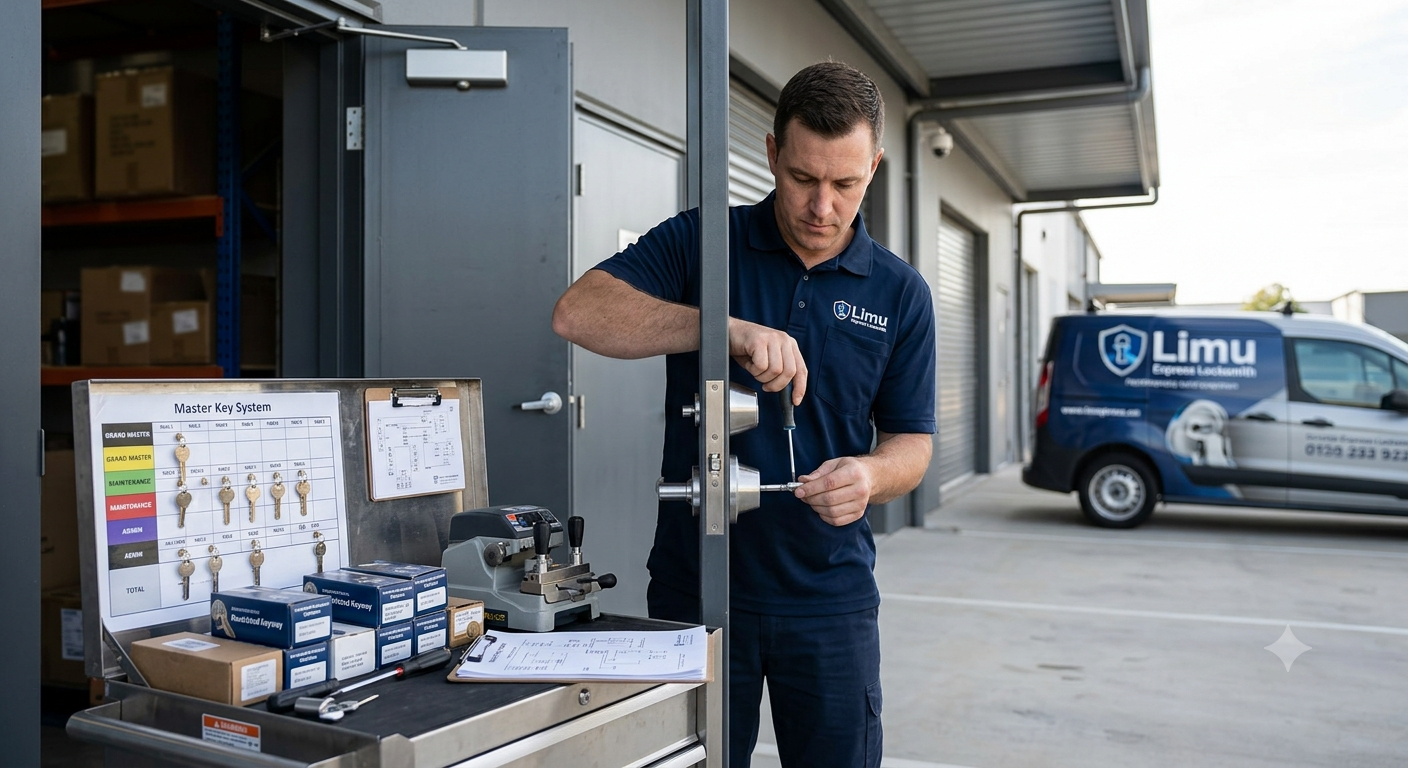
A custom-designed Master Key System provides layered physical access control across an entire facility without requiring expensive electronic badge readers or battery-powered smart locks. This hierarchical structure balances security with operational efficiency.
┌────────────────────────────────────────────────────────────────────────┐
│                   COMMERCIAL MASTER KEY HIERARCHY                      │
├────────────────────────────────────────────────────────────────────────┤
│                     [ GRAND MASTER KEY ]                               │
│                (Allows Access to EVERY Door)                           │
│                (Business Owner / Executive Team)                      │
│                                │                                       │
│         ┌──────────────────────┴──────────────────────┐                │
│         ▼                                             ▼                │
│  [ MASTER KEY: DEPT A ]                       [ MASTER KEY: DEPT B ]   │
│  (Warehouse Manager Access)                   (Office Manager Access)  │
│         │                                             │                │
│   ┌─────┴─────┐                                 ┌─────┴─────┐          │
│   ▼           ▼                                 ▼           ▼          │
│[Change Key] [Change Key]                     [Change Key] [Change Key] │
│(Dock Worker)(Inventory)                      (Admin Staff)(Accounting) │
│ (Opens 1 Door)(Opens 1 Door)                 (Opens 1 Door)(Opens 1 Door)│
└────────────────────────────────────────────────────────────────────────┘
Key Components of an Effective System:
- Grand Master Key: Opens every lock within the system, intended only for senior executives or ownership.
- Master Key: Opens all doors within a specific department, building, or function (e.g., all maintenance closets or the entire accounting suite).
- Change Key (Individual Key): Restricts employee access strictly to authorized work zones (e.g., an employee’s specific office door only).
- Strict Key Control & Restricted Keyways: The entire system relies on restricted keyways. These patented key blanks are not available at hardware stores or local kiosks. Duplication requires authorization verification (signature protocols) from the registered business owner at an authorized security locksmith location.
Life Safety Compliance: Panic Bars, Fire-Rated Devices, and Door Closers
Commercial exterior doors are subject to strict building codes (NFPA 101 and ADA requirements) that mandate unhindered egress during emergencies. A commercial locksmith ensures security hardware remains code-compliant.
- Panic Bars and Exit Devices: These devices allow immediate, single-motion push release during an emergency evacuation, even if the door is locked from the outside.
- Fire-Rated Hardware: Special fire-rated devices are engineered to maintain their latching integrity under extreme heat, preventing a fire from spreading through breach points in a fire-rated wall assembly.
- Heavy-Duty Hydraulic Door Closers: Ensure that exterior perimeter doors latch completely and securely every time they are opened, maintaining building security, fire separation ratings, and climate control efficiency.
By integrating robust ANSI Grade 1 hardware, implementing a hierarchical Master Key System with strict key control, and adhering to life safety codes, businesses can create a secure environment that protects both physical assets and personnel.